

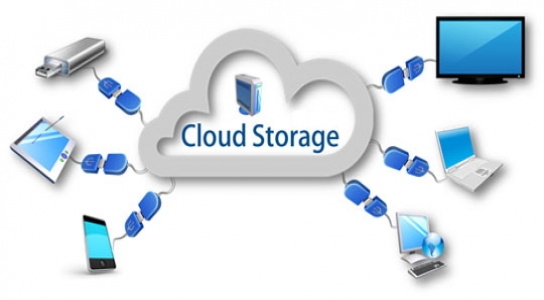
You might be wondering, “What is cloud storage?” It’s a data management system that allows you to store your data and documents in a secure location off-site. It can be viewed at any time and from any location, but not by just anyone. It can only be accessed by someone who has the password, whether they are using a public or private internet connection. When you upload all of your data and files to the cloud, storage becomes the responsibility of a third party, the cloud provider.
Anyone can now store digital data and access it from anywhere thanks to cloud services. As a result, cloud storage functions as a virtual hard drive. Cloud storage is a versatile system that may be used to save essential data such as word documents and video files, as well as accessing the cloud to analyze complex data and execute apps. The user must first establish their use cases before deciding on the appropriate cloud storage. Let’s have a look at the various cloud storage options :

Private Cloud Storage
Enterprise or internal cloud storage is another name for private cloud storage. In this situation, data is saved on the intranet of the firm or organization. The company’s own firewall protects this information. Private cloud storage is a wonderful alternative for businesses that can control data privacy in-house and have pricey data centers. A major benefit of storing data on a private cloud is that the user has complete control. The cost and labor of maintenance and upgrades, on the other hand, are some of the biggest disadvantages of private cloud storage. The hosting business is responsible for managing private cloud storage.
Public Cloud Storage
Public cloud storage requires few administrative restrictions and can be accessed online by the user and anybody else who has been granted permission by the user. The user/company does not have to maintain the system with public cloud storage. Because public cloud storage is hosted by many solution providers, there is minimal room for customization in the security fields, which are shared by all users. AWS, IBM Cloud, Google Cloud, and Microsoft Azure are some of the most popular public cloud storage solution providers. Public cloud storage is simply scalable, cost-effective, and dependable, with real-time monitoring and zero maintenance.
Hybrid Cloud Storage
Private and public cloud storage is used in hybrid cloud storage. Hybrid cloud storage, as the name implies, gives users the best of both worlds: the security of a private cloud and the customization of a public cloud. With the help of cloud computing services, data may be stored on the private cloud, and information processing duties can be assigned to the public cloud as well. Hybrid cloud storage is cost-effective and allows for greater customization and user control.
Community Cloud storage
Community cloud storage is a type of private cloud storage that caters to specific enterprises or communities. Cloud storage providers in this approach give their cloud architecture, software, and other development tools to satisfy the needs of the community. To manage the community’s security and compliance demands, all data is stored on the community-owned private cloud storage. Community cloud storage is an excellent choice for businesses in the health, finance, or legal sectors that have stringent compliance requirements.
Issues That Could Arise
- Even after updating IT solutions and technology, users may have some security problems, such as occasional breaches.
Third-party (cloud service providers) control over users’ saved data access, transfer, sharing, and monitoring.
- Data transmission may be delayed if there is a lot of traffic or if the network is slow. This is especially true while using a public internet connection.
- Regulatory compliance may impose restrictions on you and cause disruption in your business operations. Following rigid restrictions might be somewhat odd.
- Uncertainty about data privacy and archival standards can arise.
GBCloud
- Easy to manage
- A cost-effective option
- Best personal backup
- There is a live chat option
Read More GBCloud